History of Woodruff Scholars, Fellows, and Professors
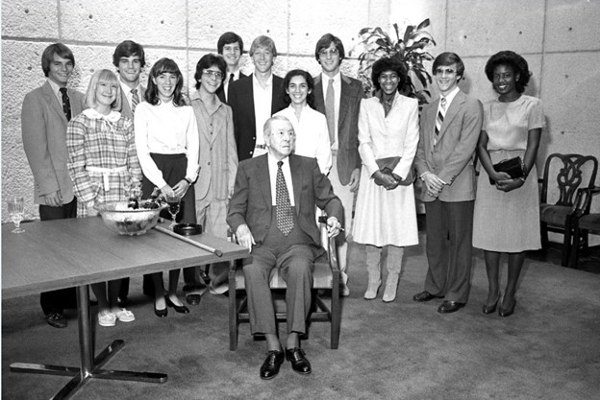
Since 1980, the Woodruff Scholarships and Fellowships have been awarded to Emory University’s top students in every field. Woodruff qualities are shared across the schools and carry on Geroge W. and Robert W. Woodruff’s legacy of passionate intellectual curiosity, creative leadership, and a strong motivation to use one’s talents and skills for the benefit of others rather than individual glory.
Woodruff Scholars and Fellows are invited to be questioners, innovators, debaters and global citizens. These awards were designed to support their intellectual curiosity and civic leadership. In support of Emory’s bold mission to create, preserve, teach and apply knowledge in the service of humanity, the Woodruff Scholars and Fellows are invited to join the Emory community in order to stimulate its most rigorous thinking, elegant problem solving, deepest compassion and broader communal belonging.
The Woodruff Foundation’s generosity also provided more specialized resources, including programming designed solely for these students and alumni, and other opportunities for Scholars and Fellows. Woodruff Scholarships and Fellowships help Emory continue to attract global leaders, professionals, humanitarians and tireless innovators across all disciplines and all nine colleges.
The Gift
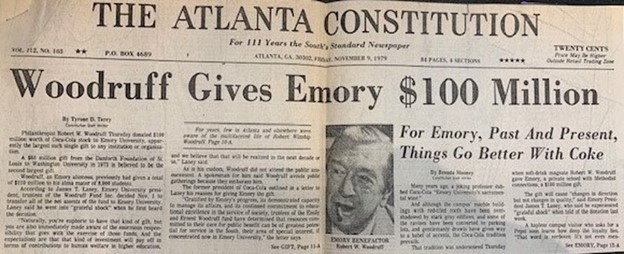
In November 1979, Emory received an unprecedented opportunity—a $105 million philanthropic gift from the Emily and Ernest Woodruff Fund that gave Emory leadership the chance to make a transformative investment in the university’s most important resources—its students and faculty.
President James T. Laney and other university leaders envisioned this gift as a way to attract the nation’s most esteemed faculty and recruit the brightest students, regardless of financial background, to build an intellectual community capable of making an impact on the Atlanta community, the nation, and the world.
The Foundation of the Woodruff Scholars and Fellows Program
1938
- Emily and Ernest Woodruff, together with their son Henry, establish the Emily and Ernest Woodruff Foundation, initiating one of Georgia’s most influential philanthropic legacies. Over the next four decades, the Foundation supports education, medicine, the arts, and civic life, with Emory University as its principal beneficiary.
1963
- Sanford S. Atwood becomes the 16th President of Emory University.
- He formalizes the goal of making Emory University a world-renowned research university.
1977
- James T. Laney becomes the 17th President of Emory University.
- He will immediately deepen the ties between the Woodruffs and Emory University.
November 8, 1979
- The Trustees of the Emily and Ernest Woodruff Fund, Inc. announce the dissolution of the Fund and the transfer of all remaining assets, valued at $105 million, to Emory University. George Woodruff announced the news to the Emory University Board of Trustees, and Robert wrote a letter to President Laney. At the time, this sum was the largest single gift ever made to an American university. The gift is endowed in perpetuity to support Emory’s mission.
1981
- Income from the Woodruff endowment establishes the Robert W. Woodruff Scholars and the George W. Woodruff Fellows Program. The first class of Scholars and Fellows matriculates across Emory’s undergraduate, graduate, and professional schools.
1981–1985
- The program expands through a highly competitive, merit-based selection process emphasizing academic excellence, leadership, character, and service. By the mid-1980s, more than 160 Woodruff Scholars and Fellows have joined the Emory community.
March 7, 1985
- Robert W. Woodruff passes away just before the Woodruff finalists arrive on Emory’s campus for weekend interviews.
2020
- The Woodruff Program 40th Anniversary Gala was held in Emory’s newly built student center with former President James T. Laney in attendance.
- The Woodruff Alumni Advisory Board is founded.
Today
- More than four decades later, the Woodruff Scholars and Fellows Program remains central to Emory’s academic identity and continues to reflect the Woodruff family’s commitment to excellence, leadership, and service.